Kiri and Steve.co.uk

line

Ah mountains, how we’ve missed you

June 6th, 2014 (by Steve)

Satnavs are never wrong. Ever. Points of interest that you’ve loaded into them are also never wrong. Ever. And routes chosen to get to said points of interest (in this case a campsite) are never wrong. Ever. And it is precisely for these reasons that we found ourselves on a narrow path which looked like it had been broken up by the result of some tectonic plate movements, whilst being brushed on all sides by trees. But we were definitely going the right way and there would definitely be a campsite at the end of it. There wasn’t. Hey, at least we didn’t have to go back the same way… oh, wait, yes we did!

What with both the campercontact POI and the TomTom POI for our planned campsite leading us to places which wouldn’t remotely look like campsites, even if you screwed up your eyes really tightly, we did what anyone in our position would do; retire to a Lidl car park to re-assess and get online. Alas, there was no internet signal, so we winged it and stopped at the first campsite we saw at the side of the road. The access to it was… ummm… a bit of a steep descent, but the price was right and after a conversation in a mix of Slovakian, German + English (conducted whilst stroking a lovely dog who gave us a very enthusiastic welcome), we realised that we had somehow landed ourselves on a beautiful terraced campsite next to a stunning reservoir. A great place to spend our first night in Slovakia. Spontaneity 1, planning 0!

lake

The following morning, we soaked up the surroundings, topped up and emptied the necessaries and had a couple of slightly disappointing showers before trying to leave. Yes, I used the word “trying” there. Bertha doesn’t like going up hills. Especially when her engine’s not fully warmed up. On the first attempt, we got half way up the hill before stalling, so rolled back down to get a bit of a running start. The second time was better (with a little more choke), getting us up to the corner, where once again we stalled (this time, my bad clutch control after a bit of wheel spin). Back to the start (where the campsite team were watching this amusing spectator sport). This time, Kiri got out and ran ahead of Bertha, which seemed to be the motivation that Bertha was waiting for, as she made it all the way to the top, with no problems at all. We were on our way and boy, did we have some lovely views during the drive.

drive

Our destination was the ski resort of Tatranska Lomnica, with the promise of a free car park. This time our trusty TomTom didn’t let us down and after a quiet night in the shadow of the mountain, it was time to explore. Now I’m not sure whether our previous blog posts, photos or videos of the trip so far have fully communicated how much Kiri loves mountains? It’s a lot and as we were so close to this one, there was no getting out of climbing it (not that I really wanted to get out of it). Ideally we wanted to get to the very top (Lomnický štít), but with no walking routes and at a cost of 26 Euros each to use the cable car from the 2nd station (Skalnaté Pleso) up to the peak, we decided instead that we could cope with just hiking up to the 2nd station.

It was a stunning walk and the weather was just right; a mix of sunshine and cloud (with the occasional spot of rain) ensured that we didn’t get too hot, but that it was nicely pleasant. Rather than taking the most direct route, we chose to walk across the mountain to Hrebienok, then up from there. This provided us with mainly forest walking throughout the 11km hike (it sounds more if you write it in kilometres rather than miles!) on a path reinforced with large boulders. There were some awesome, thundering waterfalls on the way and some cracking viewpoints from which we could (almost) spot Bertha hundreds of metres below us (898 to be precise once we were at the top). Actually, we didn’t make it to the “proper” top, but we did get to Skalnaté Pleso, which gave us some pretty good views up to the peak.

walk

And here came our dilemma… we had to get back down. Now I’ve got a dodgy knee (after an accident with some Heelys 8 years ago… don’t ask!) and even with the use of walking poles, going downhill is quite painful. However, a single ticket on the cable cars down to the car park came to 13 Euros each. Should we walk, or be carried? Kiri (with her greater fitness level than me and lovely knees) was up for walking, whereas I was up for being carried. We toyed with the idea of a compromise of separate descents (I bet you thought the compromise was Kiri carrying me!), but I wasn’t happy about Kiri on her own on a mountainside. She had a point when she said she’d done the whole coast to coast on her own, therefore she would have been fine in this situation too, but in the end she saw sense (can I get away with saying that?!). 26 Euros later, we were sitting in Bertha, replenishing our salt levels with crisps and nuts and replenishing lost fluid with a lovely local beer (as well as water – don’t worry Mum!).

route

We really have missed the mountains – don’t get us wrong, the flatlands of northern Europe have been beautiful – but mountains are something else.

Posted in KIST 2EU | No Comments »

The salt’s all mine!

June 2nd, 2014 (by Steve)

Parking appears to be big business in the south of Poland; at Auschwitz we (nay, I) blindly followed the directions of the first person in a hi-viz jacket to a car park before thinking “hang on, we want to be somewhere else”, then going there. Wise to this ploy though, in Wieliczka we passed the hoards of hi-viz-jacket-wearing touts and hung on for the official car park. I swear that this town’s main income (after the salt mine) is car/coach/motorhome parking!

Once tucked away in the corner of the official car park, we assessed our surroundings. We had a parking space, a 24 hour guard, free municipal wifi, and access to a toilet block for our 30 zloty, but nowhere to fill up with water (unless we tapped a fire hydrant… now there’s a thought!). We also needed to empty our toilet… but weren’t sure whether we’d be allowed to in the shiny-looking toilet block. Commence operation flush! After monitoring the guard’s movements (no, not like that) for about 15 minutes, we realised he occasionally left his post, which would give us time to heft our cassette across to the block without him noticing. Timing and subtlety would be everything. The guard moved… we stirred… but then he was back at his post. Too slow. He moved again, and we were off. Apparently my nonchalant swagger whilst carrying a Thetford toilet cassette across a car park coupled with whistling isn’t particularly subtle, but it was enough to fool the guard. Mission accomplished! Ah, the joys of motorhoming; doing stuff that you would never think about in normal life!

Anyway, enough about loos… we were at the salt mines; one of the greatest attractions near Krakow, with over 1 million visitors a year. Our guide for the day was Magdalena; without whom the tour would have been as boring as walking around a mine for 3 hours talking about salt. The injection of her dry wit and humour throughout really brought the tour to life though, and we found ourselves rather captivated by the tiny fraction of the 300km of underground tunnels, chambers and lakes we saw. We also learned that Magdalena is allowed to lose up to 5 tourists a month in the mines and that you shouldn’t talk to strangers underground. 2 hours into the tour, we were shown a map with 3 queues to join; 2 would take you to the surface and the third would take you on the remainder of the tour. As we joined the third one, we were warned by another guide that it would take another hour and be another 2km of walking. We said that was ok. Another guide then checked that we were sure that we wanted to continue, rather than return to the surface. These dissuasion tactics didn’t work on us (thanks Ju + Jay for the advice!), but they must have on some; our group now consisted of us and a Japanese lady, rather than the 40 who started with us. We’re definitely glad we stayed; the second part was just as engaging as the first.

mine

As our eyes adjusted to the sunlight once we were above ground again, our quest was to find water (all of that salt makes you thirsty!). The local supermarket had 5 litre bottles for 1.55 zloty each (approximately 30p), so we grabbed a couple of those and topped up Bertha’s fresh water tank, before proceeding to consume Paluski… a very tasty, but salty snack!

The following morning, we paid a rather bemused guard for another night in the car park (it’s cheaper than a campsite for visiting Krakow) then headed for the 304 bus stop. We had an hour and a half to spare until the start of a church service we wanted to attend in Krakow, so plenty of time. We waited. No bus. Half an hour later, no bus. So we headed to the train station… next train in an hour and a half. We tried another 304 bus stop… this one had a red line through it, which is a pretty universal sign for “not in use” (maybe it should have said “404 – not found”?). Doh. As we arrived at the 204 bus stop, we saw a temporary “304” sign on it, so caught the 304 bus into town, arriving exactly 10 minutes too late for church. Maybe God didn’t want us to go? So, instead we watched some people defying physics with bikes.

bikes

We could have watched the flying magicians all day, but we realised that we would miss out on the rest of Krakow, so we ventured into the old town, where we found a procession of children, dragons and drums in the main square. As you do. All this surrealism works up an appetite and the street food we sought was the zapiekanka… a cross between a Subway and a pizza. The way to enjoy it is best described with a picture I think:

nom

Having consumed our body weight in cheesy bready tastiness next to a purple Trabant, we returned once more to the centre of Krakow, where once again we encountered people in strange costumes. We also encountered a protest (not sure what it was about) and hoards of people trying to push city tours in our faces as we tried to find suitable postcards to send back to the UK. Having narrowed the choices down to two (which we named “trippy” and “creepy”… we’re all about the unique postcards!), we decided that we’d maybe had too much excitement for one day, so retreated to Bertha back by the salt mines.

As we woke on our 3rd morning at the mines, Bertha’s fresh water warning light was flashing ominously. We passed the guard on our way to get another few bottles of water from the supermarket, who kindly charged us only 20 PLN for our final night here (“maybe if I reduce the price, these crazy people will leave?”). With 20 more litres of water in Bertha (and plenty more than that falling from the skies), we set off for Krakow again; finding it rather more subdued and rather less surreal than the previous day. We dutifully wandered around Wawel Castle, but we weren’t really “feeling it” as we were both feeling a little under the weather (in more ways than one). So, we found shelter in the Milk Bar and had our first proper meal out of the trip (with real crockery and knives and forks!); 2 courses and drinks for under a tenner for us both. You can’t say fairer than that. At least not in Polish. Actually, we can’t say much in Polish…

milkbar

Having selected “creepy” over “trippy”, we bought stamps, then returned to the salt mines on a very crowded bus. I’ll give you a clue where we’re off to next, with a story that one of my friends told me. He’d been looking for a cleaner for his flat for a while, and finally selected a very friendly Polish girl. On her first day, he headed out to work, leaving a note asking her to hoover his flat. He returned after work to find that she’d only managed half of one room. It turns out she wasn’t a Pole after all; she was a Slovak. Slow-vac. Get it? As in slow at vacuuming… play on words…? I’ll get my coat.

Posted in KIST 2EU | 3 Comments »

A trying few days

May 31st, 2014 (by Steve)

First impressions matter… or so they say. But maybe not in Poland. As we crossed over the border from Germany, the smooth tarmac motorway gave way to an “interesting” road surface, accompanied by a sign warning us that this would continue for 13.5km. 13.5km later there was a sign warning that this would continue for a further 17km. 17km later… you get the picture. The carriageway going in the opposite direction? As smooth as a lake on a still day. Add in a few other road-surface-related signs and we wondered whether all roads were like this in Poland.

welcometopoland

It wasn’t to last though, and soon we were driving on wide, smooth roads. Bertha was just breathing a sigh of relief, when a storm of biblical proportions threw all sorts of things at us. With torrential rain, huge claps of thunder and stunning fork lightning, I’d picked a good time to swap out of the driving, so it was Kiri who had to cope with driving through flash-floods. An hour later, all was calm and the sun was shining once more as we stopped for the night at the home of a lovely German ex-pat couple who open their garden for use by motorhomes. Along with a Dutch motorhome, we were the only guests and we received a very warm and enthusiastic welcome… totally in German!

rain

This is where the tone of the blog post changes I’m afraid, for our next stop on the route was the town of Oświęcim, better known by its German name of “Auschwitz”. Why were we going there? Well, there was no simple answer really. A few years ago I went to Dachau, near Munich and I found it an extremely grim experience, seemingly devoid of hope. Why would I put myself through something like that again? Was it some kind of masochistic tourism? I battled with these questions and the best conclusion I came to was that without being in that place and seeing the scale of it, genocide would just remain a concept in my mind. I had a need to see it first hand in order to connect with the concept. I can’t put it better than Jay did – to not go would be cowardice.

If you want to know the history of Auschwitz, or what there is to see at the two remaining sites I would recommend that you steel yourself and go there. Nothing that I write about my experience will be eloquent enough to communicate the feelings you get as you walk the paths that so many people have walked before. The 3 words that kept going around in my head throughout the visit were “people are people”. You may have a different job to me. You may have a different faith. You may be a different age, have a different culture, come from a different country. But you, like me, are a person. Somewhere, someone didn’t recognise this. Labels were applied. The rest is gruesome history. After a harrowing day, we had the privilege of being able to walk out of the gates.

Yet Auschwitz isn’t a place devoid of hope. Yes, there’s a “feeling” about the place, but birds do sing. Flowers are laid. And millions of people go there every year; there’s hope in that. I only took one photo at Auschwitz (not the best photo I’ve ever taken); my aim being to capture a moment of hope – here a group of Jews having an impromptu service in the courtyard of the notorious block 11 where so many had been shot.

jewishservice

And Kiri found hope in one of the printed information boards.

artists

For once I’m at a loss to know how to end a blog post. Sorry.

Posted in KIST 2EU | No Comments »

Just another brick in the wall

May 26th, 2014 (by Steve)

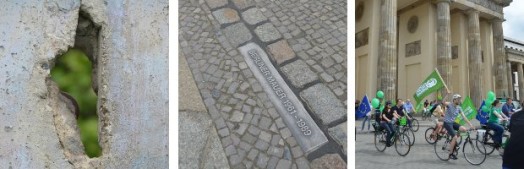
What’s the first thing that most people do when they get to Berlin? Well, I’m sure it’s not hand-washing 78 socks and a selection of other undies! Despite teamwork, we both ended up with minor blisters, and all because the washing machine at the campsite was only open during office hours. But hey, we had a lot of walking to do in the next couple of days, so those clean socks would come in handy. The following morning, we caught the U-bahn to the centre of Berlin (48 hour pass for 16.90 Euros each which also gave us several touristy discounts) and 20 minutes later we stepped, blinking, into the city streets. The map suggested that we walked along the Berlin Wall (or part of it) as it was the 25th anniversary of its fall. 10 hours later we were glad we’d done it, but quite exhausted!

Both of us are too young to really remember the events of 1989, however we were keen to expand our knowledge and one of the best places to begin was at the Berlin Wall memorial near Nordbahnhof. This is an area of the “death strip” that has been preserved, with not only “The Wall” (the 12 foot high concrete blockade on the border), but also the patrol area on the East Berlin side with markings where the various other barriers were to stop people escaping to West Berlin. Yet in this solemn environment and against a soundscape of names being read out (of those people who had died at The Wall) people were posing for “selfies”. I’m not against selfies in general, but it didn’t seem an appropriate place.

memorial

After seeing several hundred motorbikes drive past as we tried to cross the road (not sure what that was about!) we followed a path alongside existing sections of the wall that took us through a memorial meadow. Where the original wall had been removed, in its place, throughout the city, a double row of paving bricks marked its presence; a subtle scar to remind people of a divided city and a different time. This physical line etched through Berlin took us past the Bundestag (the parliament buildings, which are now symbolically linked by a bridge across river) and down to the Brandenburg Gate where various demonstrations were taking place on the eve of the European elections.

wallwalk

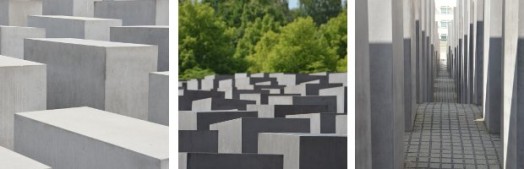
Just past the Brandenburg gate, we took some time to take in the memorial to the murdered Jews; a square packed with what initially appear to be uniform blocks of concrete on a grid. You think you have the measure of it from the outside, where the stones are at waist height, but as you start to walk between them, soon they tower above you and you lose your bearings as the undulating ground between these monoliths stops any form of regular footstep. What got me the most though was that due to the density of the towering blocks, it’s impossible to know whether there’s one other person in this maze or several hundred. This seems to be a very fitting memorial to those who were murdered… and very moving too.

jewishmemorial

Potsdamer Platz thrust us back into the 21st century with a huge advert for the iPhone 5C on what would have been the East Berlin side of the square, dwarfing parts of The Wall which provided yet more historical information. There’s not really any need to visit a museum in Berlin, when information is so available and public on the city’s broken past. The next part of the tour took us via the “Topography of Terror” that read through from 1933(ish) to 1989, covering the rise of Hitler and the Third Reich, followed by the fall and the division of Berlin, through the rise of the Wall, followed by the fall. To go off on a slight tangent, Kiri and I are currently reading through the book of Romans in the bible and have just covered the first part of Romans 13; all about submission to authorities. Not sure how that sits against the backdrop of Berlin’s recent history…

With our wallets helping us to resist the temptation to go on a “Trabi Safari“, where you get to drive a Trabant through the streets of Berlin (well, we’re already driving a museum piece around the whole of Europe!), we moved on to Checkpoint Charlie, where you could pay to pose with someone dressed as an American soldier. I was a bit disappointed that such a key location in the Cold War conflict could be reduced to this for the sake of tourists… but then again the other tourists seemed to be loving it, so who am I to judge?

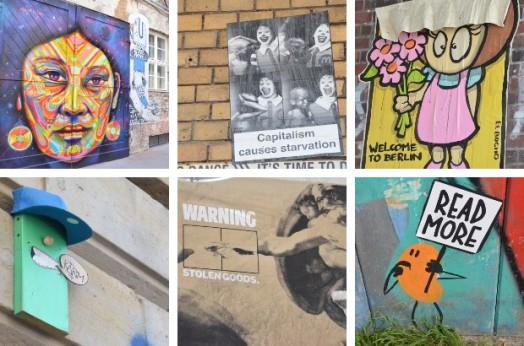
The final part of the suggested walk (you can see why it took us 10 hours to make it round!) was to the East Side Gallery; a part of The Wall where artists were invited to paint murals in 1990. As we were flagging a little by this stage, we caught the U-bahn to the nearest station and refueled with a doner kebab. We’d been told that in Germany, kebabs aren’t things only to be sampled at 2am, after a heavy night. Sam was right… a delicacy to almost rival Serbia’s pjeskavica… with probably similar Turkish origins. Replete, we viewed 5 years worth of grafitti on top of the murals which had been re-painted in 2009 whilst musing on whether the grafitti was disrespectful to the artists, or just the way things are when it comes to street art… which provides a nice segway to the next day (no, we didn’t go on a segway tour); a street art tour.

But, as it was a Sunday, church came first. This trip has really been an education for us in the different ways that people “do” church. The church we chose this week met in the large Cinemaxx building in Potsdamer Platz and it was really welcoming. The service was a slick multimedia production, full of energy and zeal, but not much depth and time for contemplation. The part of the service which grated a little for both Kiri and me was a song with the repeated words “Speak Lord”. If God had been wanting to speak during that song, I’m not sure He would have got a word in edgeways.

After church we grabbed a pretzel to accompany our cheese, meats and salad before setting off on the alternative walking tour of Berlin; a walk promising street art and visits to skate parks, artists’ squats and abandoned warehouses. The tour started with a clarification on the difference between grafitti and street art. The former is about getting your name “out there”, often through tagging. The latter is a protest against those with money getting to choose what people see on the streets; it’s about reclaiming city space for art. Sadly, there were no squats, skaters or warehouses, but there was plenty of street art and soon we got to recognise the different artists and “crews” around the city. We also passed an extremely cool “flea market” (although it was more like a festival) that happens every Sunday.

streetart

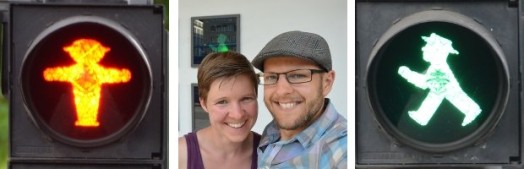
Matt, our guide, was very knowledgeable about the street art scene, but it was in chatting about politics that we really got value for money (in my opinion). It was fascinating to hear him talk about his parents’ life in East Berlin (Matt was only 1 when the wall fell) and his current interest in European politics (he’s doing a Masters in some form of European relations). Who would have thought that it would be a region of former West Berlin where there were riots recently when a McDonalds opened? The tour finished at the site of the Berlin air drop; Tempelhof airfield where that very day a referendum was being held about whether apartments would be built there. With the tour over, we planned to return to the flea market, but (rather uncharacteristically of me), we couldn’t remember which U-bahn stop it was near, so we headed to a shop dedicated to the former East Germany traffic lights, before having another kebab.

lights

There is way too much in Berlin to see in just 2 days (and probably way too much to try to cram into a single blog post), so we’re glad that it’s only a couple of days drive away from the UK (in a vehicle other than Bertha!) so that we can explore more of it in another season of our lives. But for now, it’s “au revoir” (or something like that!)… heads we turn back towards the UK, tails we head further east. Well, actually, as it’s me, it’s slightly more scientific than that… but the outcome is the same as if it we’d flipped tails… Poland here we come!

Posted in KIST 2EU | 2 Comments »

Speeding in the sunshine

May 21st, 2014 (by Steve)

Life is full of uncertainties, as is this trip. In fact, one of life’s certainties was crushed for us in the last few days. You may remember that the last blog post we wrote was from an IKEA car park? Once complete, we headed towards IKEA with 8 Euros in our pockets (we’re the last of the big spenders). An hour and a half later we wandered out of IKEA, scratching our heads as to why we still had 8 Euros in our pockets. How is it possible to visit IKEA and not buy anything at all? This trip really is life-changing!

ikea

We thought that we’d had the last of the rain by the time we hit Hamburg, but as we headed toward the island of Rügen in north-eastern Germany, the rain came pouring down once again. We spent a bit of an anxious night in a park and ride car park outside Rostock (there was nothing to say that we couldn’t stay there… but we made sure we were out of it by 8am just in case). We could have stuck to the motorway from there, but considering the speed limits on the normal roads are out of Bertha’s reach, there was nothing to lose by going the scenic route, with pretty views, cars overtaking us and wait… what was that flash? Please tell me that speed camera got the car in front of us rather than us. Bertha, speeding? Surely that’s not possible. We don’t think that it was us… but if by some miracle we do get a speeding ticket, we’re going to frame it and mount it inside Bertha (after paying our dues obviously).

By the time we arrived onto Rügen, along roads flanked by forests and glowing fields of yellow the rain was but a distant memory and the sun once more did shine. And another rainbow… this time in the form of Camp Regenbogen.

drive

Have you ever been on a campsite which has its own woodland? Its own bakeries (yes, that is plural)? Its own supermarket? Its own bar? Its own sauna? Its own private beach? It’s no wonder that some people had booked to stay there in their caravans for the whole season. The white sandy beach lured us immediately and we spent a happy afternoon playing by the sea. Whilst I did a bit of wood carving, Kiri reproduced my face in the sand with pebbles and wood shavings, then we played “catch” with a tennis ball for a while. You know what, I even showed my legs by wearing shorts.

beach1

We retired to Bertha for dinner and a glass of wine (thanks Jeff), before once more venturing to the beach at dusk for a romantic wander. We can be forgiven (I hope) for being secretly happy that the washing machine rooms were locked… our main reason for staying on a campsite in the first place. This was well worth it though; a truly cracking campsite.

beach2

One of the key draws of Rügen was the opportunity to see a 1930s architectural wonder; a holiday camp at Prora. This was one of several seaside resorts planned by the Nazi party to be accessible and affordable for everyone. In typical German efficiency, the resort was planned and built so that every room had a sea view, resulting in a huge building stretching a kilometre along the seafront. A little different from Butlins. Due to WW2, it was never finished and, having had many uses over the last 80 years, several bits of it have now been sold off to private parties. It’s a fascinating structure; you could say that it was ahead of its time in its almost Brutalist style… or as Kiri says, you could say that it looks like a prison.

prora

As there was nowhere free to stay on Rügen in Bertha, we decided to move on towards Berlin. A rather uninspiring location of a supermarket car park (in the shadow of a petrol station offering unleaded fuel at 1.519 Euros per litre) provided a backdrop for what can only be described as a marriage-strengthening heated discussion that evening. Everything was happily resolved and by morning the sun was bright in the sky, it was obviously going to be a scorcher of a day and all was well with the world… apart from the unleaded fuel having risen to 1.569 Euros per litre. So those rumours about petrol in Germany being cheaper on a Sunday, Monday and Tuesday may have some grounding after all!

With our plan being to arrive in Berlin for the weekend (sadly a little too early for the Kill It Kid concert there on the 29th) we’re having a couple of rest days on the way. The thermometer has stayed permanently above 30 degrees today inside Bertha, so there’s not really much else we can do but sit back and appreciate our surroundings. Oh, and remain bemused as to how a 24 year old, underpowered, chugging motorhome (sorry Bertha) might have a speed ticket waiting for her back in the UK.

Posted in KIST 2EU | 2 Comments »

Little people in Hamburg

May 17th, 2014 (by Steve)

The open road. A stretch of autobahn with no speed limit. No restrictions. You can almost feel the wind in your hair. Apart from the fact that you’re in a 24 year old motorhome who is already aerodynamically lacking without opening any windows. And thus, we found ourselves pootling along at 90kph, being overtaken by cars going literally twice as fast. We did manage to hit 100kph at one point, going slightly downhill with a back-wind, but that obviously scared Bertha as she started trembling. We eased off.

From Osnabrück, we didn’t want to go straight to Hamburg, so we meandered around a little, taking in the German way of life. In the rain. Let’s say the highlights on the way to Hamburg were:

  • A strategic dinner of beans on toast (chosen because it would produce the least condensation of any hot meal; we couldn’t open the vents due to the rain)
  • An awesome double rainbow in Oldenburg – I know that it’s just raindrops refracting light to split it into its component colours, but rainbows still really excite and amaze me.
  • A request for an interview from a finance company (we politely declined, as we don’t want to be inadvertently endorsing a company or product we know nothing about)
  • Browsing the web using Lynx and the “view-source:” in Chrome to use less bandwidth

As we were living through these thrilling events, we passed the 4 week mark of this second leg and chose to mark it by having a brief confab about progress and a rough route plan. Kiri’s conclusion was that we needed to “get a wriggle on”. I got excited, then realised that she meant we needed to travel longer distances each day.

rainbow

So, Hamburg. Why did we choose to go to Hamburg? Our route through Germany has largely been dictated by the concept of umweltzones; low emission zones. As you can imagine, Bertha is not the most efficient vehicle and therefore her punishment is that she’s not allowed inside many of the cities in Germany, so Hannover was out of the question, as was Bremen… but Hamburg doesn’t have a low emission zone (we guess because it’s an industrial hub), so we headed there. Upon arrival, we parked up and wandered to the Miniatur Wunderland. Now we’re little people. We like other little people. Therefore, the prospect of seeing a little model world with lots of people excited us. Jason and Julie had raved about it, so we knew it would be worthwhile. And we weren’t disappointed.

We got there 2.5 hours before it shut for the day, thinking that this would be plenty of time to see everything; after all, it’s just a model railway with a few added extras, right? Wrong. It’s not possible to fully describe in words the level of detail that has gone into this model world. It’s impressive at both the micro and macro levels and it’s most definitely not just about the trains. There’s a fully functional airport with planes that take off and land, there’s a music festival with hundreds of miniature fans, all doing different things, there’s a petrol station with a price board that reflects the current price of fuel and there are hundreds of little cameo scenes; bank heists, inappropriate activities in bushes, murder scenes etc. Oh, and the whole thing cycles between day and night every 15 minutes, where the headlights, brake lights and indicators on every vehicle come into their own. The whole thing is controlled from a command room that wouldn’t look out of place as a city traffic control centre. We saw about half of it in 2.5 hours and definitely intend to return at some point.

wunderland

Yesterday we decided the best way to view the full-sized city of Hamburg would be to do a free walking tour (like we’d done in Amsterdam). Our guide this time had a very different style to the passionate and charismatic Robbert, but he was extremely knowledgeable and informative in talking through the history of his city. He spoke particularly sensitively about the city and its place within World War 2, drawing special attention to stumbling stones and speaking highly of the anti-war memorial of St. Nikolai church; a church that’s part of Coventry Cathedral’s cross of nails network.

The merchants’ quarter formed part of the tour, as did a church with an organ played by Bach and the new harbour development, featuring the under-construction symphony hall. But most interestingly (maybe a slight exaggeration!), we found out that in the early days of the city, it was the brewers who basically ran Hamburg, due to their pioneering use of a “secret” ingredient in the brewing process. Hops. Well, the first brewing of beer with hops may have started in Germany, but so far on the “beer loop” of our tour (as this second leg has been named by Pig and Porter), Belgium is still winning in terms of taste.

hamburg

With the Holsten Stark and Astra Urtyp sampled, we felt we’d had a good taste of Hamburg, so it was time to hit the road once again. Now this was the point in the second loop that we were going to head north into Scandinavia, but sadly we’ve realised that time and budget wouldn’t stretch to that. So, as a compromise, we set sail for Lübeck, to stay at the motorhome point in the IKEA car park! Ah, Sweden!

Posted in KIST 2EU | 3 Comments »

Currywurst with a side of pondering

May 14th, 2014 (by Steve)

I like to try to live a purposeful life. Now this shouldn’t be mixed up with the concept of a porpoise-full life; that would be way wetter and more complicated. I don’t think I’m alone in this; for centuries people have been trying to fathom the meaning of life. It’s no wonder that throughout this travelling then, I’m pondering on the purpose of it all. In the first loop, it was possible to see the fruits of our travels as we helped out at different projects and put our skills to good use, but the purpose seems to be a little more subtle in this loop.

We’ve now crossed from the Netherlands into Germany where it has rained incessantly. It might be that it’s trying to be welcoming and remind us of the UK, but we don’t really feel like we need to be reminded too much. Aside from being mesmerised by a bread-slicing machine in Lidl (the best thing since… ummm… well… maybe it is just the original best thing!), we’ve mainly been sitting inside Bertha, sheltering from the rain. Due to the wonders of Sikaflex (which we picked up more of in a camping shop), the rain has remained outside. Get in! Or not.

In the midst of the rain, we had a lovely interlude from our sheltering in Bertha; we met up with Judith in Osnabrück; a girl that Kiri was on community with at Lee Abbey (Judith that is; Osnabrück is a city). After having a cup of coffee and a biscuit inside Bertha with her on Friday, she showed us round the city before we chilled at her flat, catching up with her. We then ventured out again into the city (in the rain) where it was the start of Mai Woche (or “May Week” to you and we… you and us…? Hmmm, not sure of that one). Basically, despite the rain, the Germans were having a bit of a knees-up in the town, with live music, street bars and good food. One of our shelters from the rain happened to be a bratwurst marquee, where we were treated (by Judith) to currywurst and chips. Sehr tasty!

osnabruck

Back in Bertha, the rain continued, providing us with a lot of time to read, ponder and have meta-conversations that end up confusing both of us. What do I mean by meta-conversation? Well, I guess a conversation that soon starts to be about itself; a self-examining conversation… a recursive conversation. You start having a conversation about one thing, then it turns into talking about the conversation itself, then talking about how we’re talking about the conversation, down to many layers. A bit like Inception, but even more complicated.

It’s a strange situation to be in; most of the time in “real life” (yes, I know that what we’re doing is real life, but it’s not exactly normal!) you start to have a deep conversation or a deep pondering, then you’re dragged away by the reality… you’ve got to get back to work, there’s someone at the door, the washing needs to be hung up… you get the picture. It’s not like that for us at the moment though. It feels a bit like we’re living in a temporary, privileged bubble where we have time. We have time to wrestle with challenging bits in the bible. We have time to grapple with aspects of our personalities that may be sub-optimal. We have time to examine the intricacies of our marriage; working out how to strengthen the bits that are weak and at the same time marvelling at the bits that just work, even though they may make no logical sense. I guess you could say we’re growing.

So in one respect, the purpose of this trip can be seen in this growth, but despite my Lenten endeavours to focus on fruitfulness, I still like to see tangible outcomes. All of this talking without any action points hurts my head. Abstract is good for a short while, but I like concrete implementations (an analogy for the techies maybe?). We have no concrete plan as we float around Europe… aside from returning to the UK before we run out of teabags (very complicated maths has been used to calculate when this may be). Can you be purposeful without a plan? I’m learning (slowly and reluctantly) that maybe you can.

What is the meaning of this trip? What is the meaning of life? I don’t know, but I do know that taking time to grapple with these questions (and other, deeper questions) is strangely rewarding. The more pertinent question though is whether we’ll be able to build time into our post-trip lives to continue the wrestling. Especially when kids (or porpoises?) might start arriving on the scene at some point after our return to the UK. But that’s something to think about at some other time.

Posted in KIST 2EU | No Comments »

Cheesy clogs

May 9th, 2014 (by Steve)

Windmills? Yup. Canals and dykes? Yup. Bicycles? Yup. Cheese? Kind of. Clogs? Nope. Well we needed to do something about that! You can’t go to the Netherlands and not sample the cheese and clogs! By total chance, our next overnight stop was outside a cheese and clog farm near Volendam. As we pulled up, we saw the clogs grazing in the pastures, ready for herding… no, wait, that was just a dream I had, not reality.

All we expected from the farm was a little shop in the same way you might have a farm shop in the UK. We certainly weren’t ready to be greeted by a lady in traditional Volendam costume who talked us through how they make gouda, edam and clogs by hand, before letting us sample lots of different types of gouda. We’d already tried gouda with cumin seeds from a supermarket, but there were some fantastic cheeses here; our favourites being an awesome mature gouda (sadly out of our price range) and a pretty good gouda with stinging nettles. Nettles are apparently good for your skin, as is cheese…? Maybe? Maybe the nettles offset the badness of the cheese? In any case, it was very tasty! We then watched a demonstration of clogs being made; out of poplar wood, not cheese… I certainly think there’s a gap in the market for cheese clogs though!

simonehoeve

After staying for the night outside the farm, we wandered into Volendam for a sunday morning service at a much smaller church than the previous week; more akin to a little Welsh chapel. The service had a very different feel to the previous week’s in Middelburg and it was still a lot more traditional than we’re used to, but it’s great to be able to meet with God in different ways, through different traditions. Following the service, we joined the rest of the congregation for a cup of coffee and some lovely biscuit/cake thing (should probably find out which for VAT reasons!) and had a lovely chat with a family from Delft (who were also visitors). It’s great to find instant community that cuts through cultural differences.

church

From Volendam, we slowly migrated up the coast and across Afsluitdijk; a marvel of Dutch civil engineering. It’s basically a dam or dyke (I wonder what the technical difference is) cutting off a section of the north sea to protect the Netherlands. It’s the equivalent of putting a dam across the Bristol channel from Lynmouth to Porthcawl… no wonder the Dutch have a name for being some of the best civil engineers in the world. Not sure why you’d want to get from Lynmouth to Porthcawl though, aside from avoiding the toll! We stopped for lunch (of the nettle cheese, obviously!) just shy of half way along its 30km length before moving on to the land of pure-bred Friesian cows (they apparently have a lower milk yield than cross-breeds, but it’s better quality).

afsluitdijk

As we hit dry land again, we were met by hoards of kamikaze flies targetting Bertha. Incidentally, I might not know the airspeed velocity of an unladen mosquito, but I do know that African mosquitos don’t bite me, but European ones do! With our screenwash level dramatically lowered, we stopped overnight at a farm in the shadow of a wind turbine. It turns out these upgraded windmills are surprisingly noisy when you’re close to them, but I think it’s a small price to pay for the benefits of renewable energy.

From the farm, it was only a short drive to Leeuwarden (which I have consistently pronounced incorrectly… I would just like to take the opportunity to apologise wholeheartedly to Dutch people everywhere for destroying your beautiful language with my attempts to speak it). Once there, we pulled up at a prime canal-side spot and prepared Bertha for her first ever dinner guest. Alex (who I sing with in a barbershop group) works a few days a week in Leeuwarden so it was lovely to be able to entertain a “local” who could then show us around the town a little.

leeuwarden

He invited us out for drinks the following evening, which we enthusiastically accepted, despite having previously planned to move on. However, changes of plan can have rather large consequences when motorhoming. We weren’t sure that our toilet would last another night and our overnight stop didn’t have disposal facilities. So started our quest, which led us further and further away from the city I can’t pronounce. By the time we were 20 miles away and still hadn’t found somewhere to empty, we realised that maybe we should return to plan A and just move on. With a heavy heart, we bailed on Alex and headed for the German border. I wonder if we might be the first people who have used the excuse of a full toilet for going to Germany?

Posted in KIST 2EU | No Comments »

The city of water-retaining ‘amsters

May 6th, 2014 (by Steve)

Since starting this trip, we’ve viewed campsites as easy options for overnight stops; you pay a bit more for the convenience of it all. You certainly don’t expect to have to be towed by a tractor, or be hit by a flying duck in the middle of the night. We experienced both of these things at the Fawlty Towers of campsites outside Amsterdam… but strangely enough, we’d still recommend it as a good spot for seeing the city!

A short walk along a dyke followed by a couple of short bus journeys and we were in the heart of Amsterdam. We had heard many stories about this city and what it was like, but we wanted to make our own minds up about it. The best way to get the lowdown? A free walking tour. I’ve been on several of these walking tours before in Munich, Riga and Budapest and because the guide’s only payment is tips at the end, its in their best interests to make the tour engaging, informative and humorous. This one was with the same company that operates the Munich walking tour and our guide was a local Dutch guy (who’s also a drummer!); Robbert van Hulzen, who succeeded on all 3 counts.

tour

The tour took us on a historical tour of Amsterdam, taking in places such as the location of the first multinational company in the world, the house of one of the oligarchs who ruled the city, the controversial red light district, the “coffee shops”, a gated community of single females, the house of Anne Frank, a cheese shop, finally ending up in the slightly Bohemian Jordaan district. All the while, Robbert was talking honestly and candidly about his city, his country, his people and their outlook on life and living with others. The main philosophy that we heard about many times spoke of tolerance, acceptance and support within a city full of diversity.

amsterdamtour

On the surface, this approach to life seems great and indeed it’s this way of living that has allowed Amsterdam to be a place of refuge for many people over the years. It also led to a general strike when the Jews were being rounded up in WW2; neighbours putting aside differences and uniting against the Nazis. However, Robbert was very sensitive in also revealing the darker side to this openess. Apparently without the openess and co-operation with the Nazis when they were an occupied city, far fewer Jews may have died. The “coffee shops” (establishments licensed to sell cannabis) sit in a very complex place in the legal system; what they are providing is a decriminalized product, yet the growing and the procurement of said product is still illegal. And then there’s the red light district. It’s a jarring place. My mind couldn’t process that the mannequins were in fact human. I can accept that it is a safer place for prostitution than where we saw it in Spain; on the sides of main roads. Yet I still can’t get my head around it.

I’m in no position to judge how someone lives their life… in fact I don’t think any human has that right. So I can see where the acceptance philosophy fits in, but how do you avoid the dark side (without being a Jedi?!)? I think the first step is love for others (in a brotherly sense of the word), but I don’t know what the next step is. Is it possible to express sadness at what you perceive may be a damaging way of living without that sounding like judgement? Is the mere action of perceiving something to be a damaging way of life an act of judgement? Most people have an idea of the concepts of right and wrong… how do you reconcile differences between those moral codes though? Too many questions. Not enough sufficient answers. Amsterdam (and Robbert) have got me pondering further on topics I’ve been grappling with for many years.

All that pondering aside, Amsterdam really is a cracking city. It’s a bit like a stack of stroopwafels; it’s got so many layers. It’s not just a party city. It’s not just a city built on international trade. It’s not just a cultural and artistic hub. It’s so much more than all of that and I don’t think that a short visit like ours got to the toffee centre, although we did see some beautiful details.

amsterdam

Just when we thought Amsterdam (and the campsite) had given all they were going to in our short time there, there was one more little nugget. Another Talbot Express motorhome. Not just in Amsterdam. Not just in our campsite. Parked right next to us! Sadly they were just coming and we were just going, so we didn’t get to talk to them, but still, it’s ANOTHER TALBOT EXPRESS!!! I’m going to try to calm down and have a cup of tea and a stroop wafel now.

Posted in KIST 2EU | No Comments »

What’s the Dutch for “Sikaflex”?

May 4th, 2014 (by Steve)

Water is something that you become very aware of when you’re living full time in a motorhome. It’s a resource that you have to manage very carefully; being aware of how much fresh water you have left, ensuring that no water is wasted when you’re using it, then making sure that the grey waste tank (the stuff that goes down the sink, not the toilet tank) doesn’t get full. Water is everything. But sometimes you can have too much of it!

Having seen plenty of water in the form of canals at Kinder Dijk, our next destination was to be the Hoge Veluwe national park, near which we found a free aire to stay in overnight. The plan was to spend the following day cycling around the park, but we woke to ominous skies and over breakfast the heavens opened… not really the best day for cycling. We sat tight and prayed that the following day would be clear.

The mist wasn’t the best of signs as we munched our breakfast the next morning, but we nevertheless optimistically set out for the national park. After paying to enter, we set about selecting our trusty steeds for the day; two of the many white bikes which are free to be used whilst in the park. It took a little while to get used to the upright position of the bikes and braking by pedalling backwards, but actually, they were perfect for purpose. Well, our purpose of trundling around the park anyway. If your purpose was trick cycling backwards, these would not be your bikes.

bikes

The park is a combination of woodland, heathland and sandy (almost desert) terrain with over 40km of cycle paths. We chose not to explore all of them, but we probably covered 26 or 27km through the course of the day, stopping for lunch at the centre of the park, several times for photos (we especially loved an area of scorched earth through which green grass shoots were conquering) and for an icecream in the last 6km. As we wolfed down the last bit of waffle cone, the sky was darkening, so we hastened back to Bertha. It is with dented pride that I admit that I fell off right at the end of the cycle ride (I blame the stupid child seat that I caught my leg on whilst dismounting), but in my defence, the first drops of rain were falling and they were big. Once in Bertha… torrential rain; we’d (somehow) timed it perfectly!

terrain

We drove on to our overnight destination, parked up, then sat back to enjoy the thunder and lightning. There’s something lovely about being warm and dry inside when the rain is coming down in buckets outside. As Kiri found out though, there’s nothing lovely about a little trickle of water going down the back of your neck when you’re meant to be warm and dry inside. I believe her exact words were “ah” (or something to that effect), “that’s not meant to happen”. As the water plummeted to earth from the sky, so my heart plummeted also. We thought we’d fixed all of the leaks last summer. Obviously not.

After some minor investigation with a screwdriver (i.e. removing the pelmet, the curtains, the window blinds and some of the inside rear wall of Bertha), we discovered that all of the beams were dry in the wall. Good news. This one trickle of water was making its way between the aluminium and the wooden frame, then pooling atop the batten above the window, from whence it falleth onto the head of mine dear wife. That suggested a hole, rather than one of the seams leaking, so we headed outside and sure enough, a hole in the aluminium skin that I’d filled with Sikaflex previously was open to the elements; more specifically a compound of 2 hydrogen atoms bonded with 1 oxygen atom.

leaks

The rain ceased overnight, allowing us to seal the hole in the morning with copious amounts of Sikaflex (given the number of times we’ve mentioned this product on our blog, we are considering seeking sponsorship from them). Job done. And so to wend our merry way towards a dam built out of ‘amsters… now I know they can retain food in their cheeks, but who knew they could retain water!?

Posted in Bertha, KIST 2EU | 2 Comments »